


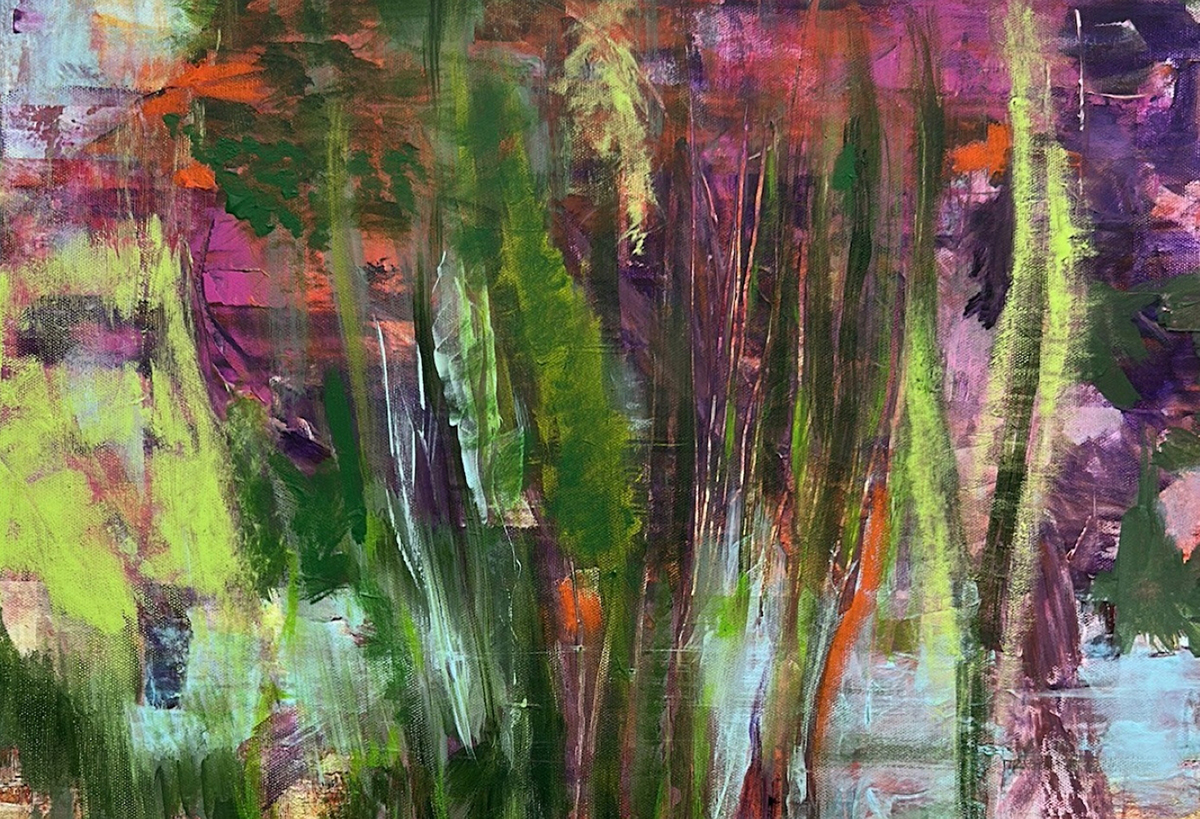
Born in Stuttgart, Germany, Sonja Kalb has cultivated an artistic identity that bridges the disciplines of design and the expressive possibilities of contemporary abstract painting. With a Dipl. Ing. degree in Textile and Design, Kalb developed a sophisticated understanding of visual relationships, material properties, and compositional balance. This technical foundation continues to inform her creative process, even as her artistic direction has evolved toward a more instinctive and experimental approach. Now living and working in Düsseldorf, Germany, she explores the emotional and sensory dimensions of color, texture, and movement. Her paintings frequently combine energetic gestures with intricate layers, allowing unexpected visual relationships to emerge across the canvas. Rather than adhering to conventional representation, Kalb embraces abstraction as a means of communicating atmosphere, sensation, and the subtle rhythms of the natural world. Her work invites viewers into environments where imagination and personal interpretation become essential parts of the artistic experience.
Exploring Nature Through Color, Texture, and Movement
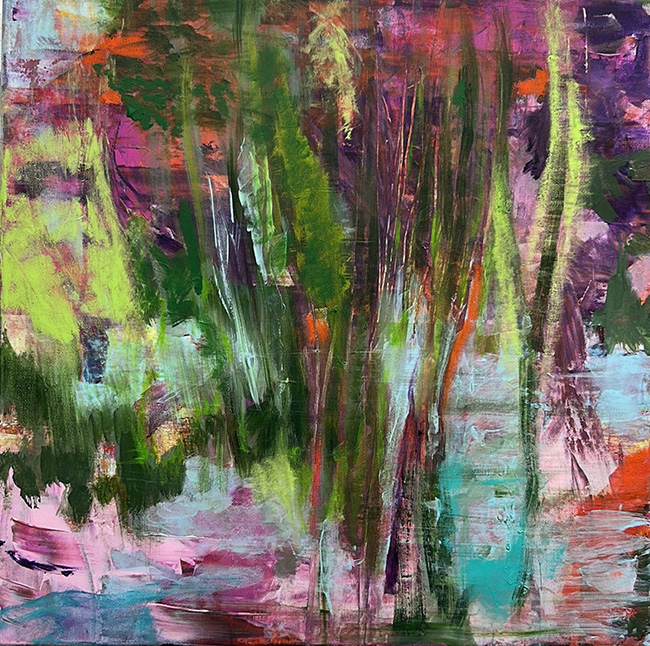
Whispering Forest I – Mixed media on canvas – 50 x 50 cm
In Whispering Forest I, Sonja Kalb transforms the familiar imagery of a woodland landscape into an evocative abstract composition filled with movement, mystery, and emotional depth. Rather than depicting a forest through recognizable trees and foliage, the artist explores its underlying atmosphere, capturing the sensations of shifting light, dense vegetation, and the quiet vitality that exists within natural environments. Through expressive brushwork, layered pigments, and an intricate arrangement of colors, Kalb creates a visual experience that moves between the recognizable and the imagined.
The painting immediately draws attention through its rich interplay of greens, turquoise, violet, and earthy tones. Deep forest greens dominate portions of the composition, suggesting the density of vegetation and the shadowed spaces beneath a woodland canopy. These darker passages are interrupted by luminous turquoise and pale blue areas that evoke reflections of daylight filtering through branches or glimmering across a forest floor. Subtle touches of pink, orange, and purple introduce unexpected warmth, enriching the painting’s atmosphere and preventing the composition from becoming a conventional interpretation of nature.
One of the most compelling qualities of Whispering Forest I is its complex treatment of texture. Kalb employs sweeping gestures, vertical markings, and overlapping layers to establish a surface that feels constantly active. Some brushstrokes appear fluid and spontaneous, while others suggest deliberate movements that organize the composition. This combination of freedom and structure generates a distinctive visual rhythm, encouraging the viewer’s eye to travel across the painting and discover relationships between its different elements.
Vertical forms emerge throughout the canvas, recalling slender tree trunks, hanging vines, or shafts of light penetrating dense woodland. Yet these suggestions remain intentionally ambiguous. Kalb does not attempt to define the landscape through literal representation. Instead, she allows color and gesture to create associations with the natural world while preserving the expressive independence of abstraction. This approach gives the painting an openness that encourages individual interpretation.
Light plays an especially important role in establishing the work’s emotional character. Bright turquoise passages near the lower and central sections contrast with darker greens and purples, creating the impression of illumination emerging from within the composition. These luminous areas introduce a sense of spaciousness, while surrounding layers suggest depth and enclosure. The resulting tension between openness and density mirrors the experience of entering a forest, where sunlight and shadow continually reshape one’s perception of the environment.
The painting also conveys a remarkable balance between tranquility and energy. Its vertical gestures suggest movement, as though branches and leaves were responding to an invisible breeze. At the same time, the softer transitions between colors introduce moments of stillness. This interaction creates a contemplative atmosphere, allowing the viewer to experience the forest as both a place of peaceful retreat and a living environment filled with subtle activity.
Kalb’s use of abstraction extends beyond the visual appearance of nature to consider its emotional resonance. Forests often carry associations with solitude, discovery, renewal, and mystery. In Whispering Forest I, these qualities emerge through the relationship between layered surfaces and shifting colors. Darker passages may suggest hidden spaces or unfamiliar pathways, while brighter areas evoke openness and possibility. The painting does not impose a single narrative but creates an environment in which viewers can develop their own emotional connections.
Another significant aspect of the work is the way individual colors interact without losing their distinctive identities. Greens establish a strong connection to organic growth, while violet and magenta introduce a more imaginative dimension. Turquoise serves as a luminous counterpoint, bringing freshness and clarity to the composition. Together, these colors form a richly interconnected visual field that reflects the diversity and complexity of natural ecosystems.
The layered construction of the painting further reinforces the idea of nature as an evolving process. Marks appear to overlap, dissolve, and reemerge, suggesting the continuous transformations that characterize woodland environments. Growth, decay, movement, and regeneration become implied through the painting’s material qualities rather than illustrated as recognizable events.
Ultimately, Whispering Forest I demonstrates Sonja Kalb’s ability to translate the essence of nature into an expressive abstract language. Through her sensitive handling of color, texture, and compositional movement, she creates a work that is simultaneously vibrant and introspective. The painting encourages viewers to look beyond the visible landscape and consider the atmosphere, energy, and emotional significance of the natural world. In doing so, Kalb presents the forest not simply as a physical location, but as a space of imagination, reflection, and enduring vitality.
