


Growing up during a time of major social and cultural change in China, Huang YI Min developed an artistic perspective deeply shaped by memory, observation, and lived experience. Born in 1950 and trained at the Department of Fine Arts at Beijing Normal University, she built her artistic foundation through close engagement with everyday life in Beijing, studying the atmosphere of streets, public spaces, and the city’s changing architectural landscape. When she immigrated to the United States in 1997, she carried with her not only formal artistic training, but also a profound connection to the cultural and historical environments that shaped her early years. Her work exists between personal reflection and collective memory, where painting becomes a way to examine how places hold emotion, history, and psychological resonance. The urban scenes she created in Beijing throughout the 1970s gradually transformed from direct observations into emotional and imaginative spaces that continue to inform her artistic practice today.
For Huang YI Min, painting has always been inseparable from her inner life. Rather than viewing art simply as a career or technical discipline, she approaches painting as an extension of thought, memory, and emotional experience. She once described painting as “the externalization of my soul,” a statement that reflects the intimate relationship she maintains with her work. This connection is especially evident in the urban landscapes she produced between 1972 and 1980, where familiar locations become deeply personal reflections shaped by atmosphere and observation.
During this period, Huang immersed herself in sketching directly from life, using Beijing itself as both subject and emotional reference point. Public squares, streets, libraries, and avenues repeatedly appeared throughout her paintings and drawings. Through oil on cardboard and works on paper, she captured not only the physical appearance of the city, but also the subtle emotional conditions embedded within it. Her paintings reveal careful attention to stillness, structure, and mood, allowing ordinary environments to carry quiet psychological depth.
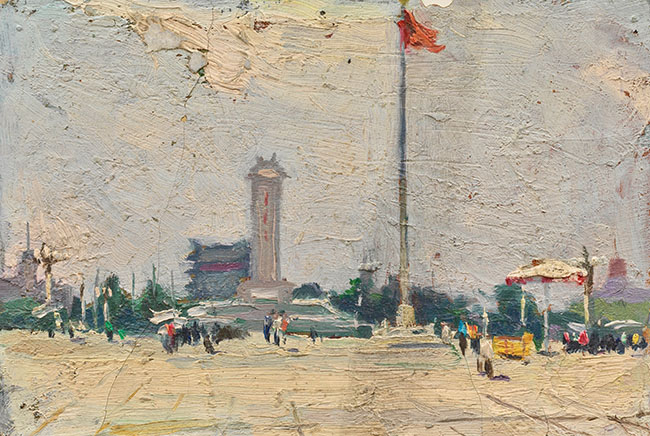
One example is Tiananmen Square in Beijing (1971), a small oil painting on cardboard measuring 20 x 15 cm. Although Tiananmen Square is internationally recognized as a major historical and political site, Huang presents it through a personal and observational lens rather than through grandeur or symbolism. The modest dimensions of the work create a sense of closeness, encouraging viewers to encounter the scene as part of daily life rather than as an official image of history. The use of cardboard as a surface further contributes to the immediacy of the painting, suggesting spontaneity and direct engagement with the environment around her.
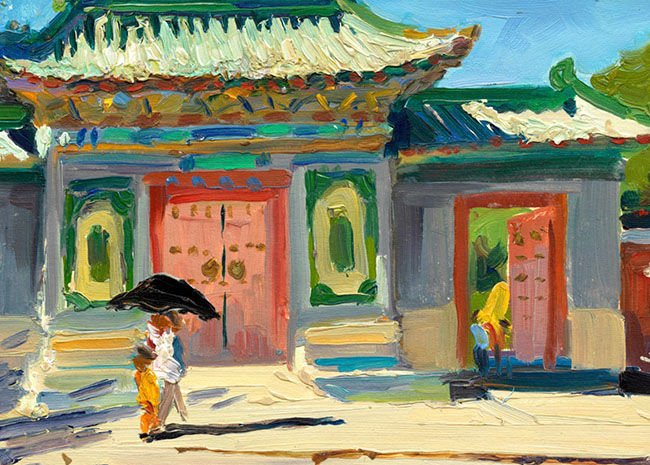
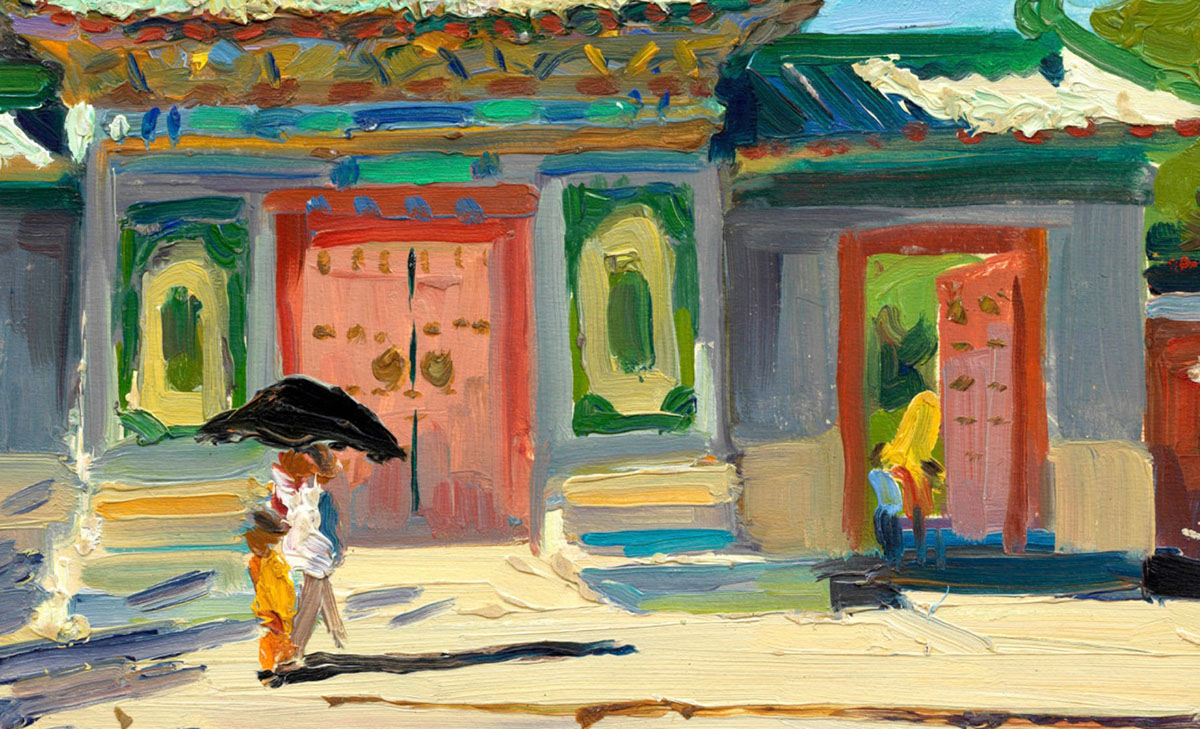
A similar sensitivity appears in Beijing Library (1972), an oil painting on cardboard measuring 20 x 30 cm. While the library itself functions as an architectural subject, the work extends beyond documentation. Huang transforms the building into a contemplative space associated with memory, silence, and preservation. Rather than dramatizing the scene, she allows atmosphere and restraint to guide the composition. The painting feels calm and introspective, revealing her ability to communicate emotion through subtle observation rather than overt expression.
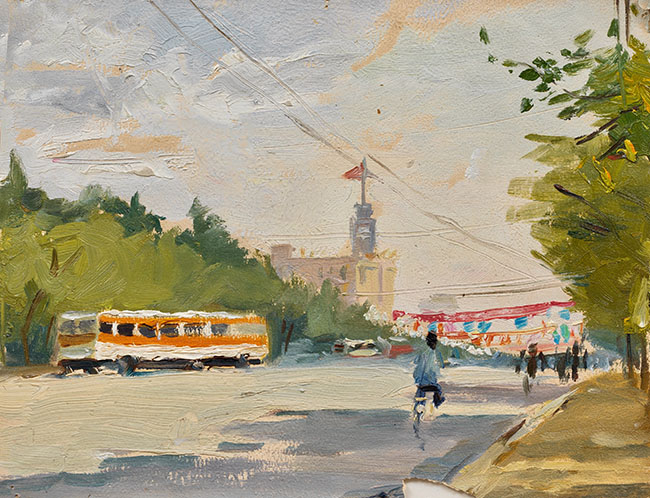
In Chang’an Avenue in Beijing (1973), painted in oil on cardboard at 30 x 20 cm, Huang focuses on one of the city’s most recognizable roads. Here, the avenue becomes more than an urban location; it represents movement, transition, and the passage of time within the changing city. Huang avoids spectacle, instead concentrating on the emotional texture of the environment. Through composition, perspective, and tone, the city emerges as a living presence shaped by memory and human experience.
What distinguishes Huang’s work is the way it moves between documentation and imagination. Although rooted in direct observation, her paintings are never limited to realism alone. Huang has explained that the Beijing cityscapes she painted during the 1970s became “the starting point of my imagination.” This idea remains central to understanding her artistic language. The streets and buildings she once observed gradually transformed into emotional landscapes where memory reshapes physical reality. Familiar places begin to carry symbolic and psychological weight, existing somewhere between lived experience and recollection.
Her practice of drawing from life also plays an important role in this transformation. For Huang, sketching is not merely a technical exercise but a process of reflection and emotional understanding. Through line, texture, and composition, she translates external observation into an inner experience. Even when depicting public spaces, her works maintain a quiet intimacy that allows viewers to feel emotionally connected to the scenes she portrays.
After relocating to the United States in 1997, the emotional significance of these earlier works deepened further. Distance transformed the paintings into connections to memory, cultural identity, and personal history. The Beijing landscapes no longer function solely as records of a city during a specific era; they become spaces where remembrance, displacement, and reflection coexist.
At the center of Huang YI Min’s work is the belief that painting preserves emotional experience. Her art suggests that cities are not simply physical environments, but repositories of memory, atmosphere, and human feeling. Through observation, introspection, and imagination, Huang transforms familiar urban spaces into deeply reflective images that continue to bridge the relationship between personal memory and collective history.
