


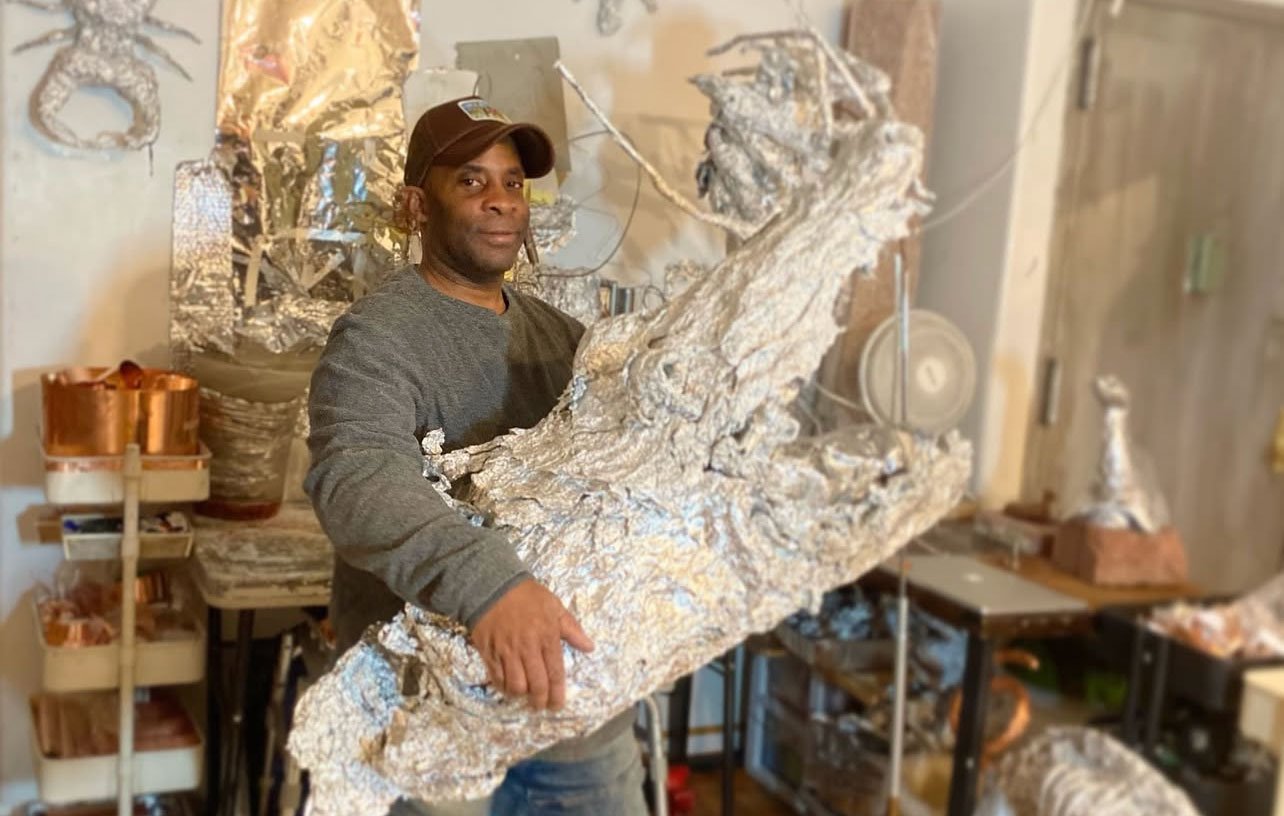
In the crowded and restless ecosystem of New York art, Dean Millien, as known as Tinman, stands apart by working with a material most people barely think about. Aluminum foil, cheap, fragile, and disposable, becomes in his hands a surprising tool for reflection, tension, and presence. This April, Dean will be part of Greater New York 2026, the highly anticipated exhibition celebrating the 50th anniversary of MoMA PS1.
Dean is best known for sculpting animals entirely from aluminum foil. Alligators, spiders, and other creatures take shape with remarkable detail and attitude. From a distance they look almost realistic. Up close, the crinkled surface catches the light and reveals every fold. The material choice is deceptively simple. Foil is something we crumple, tear, and toss without thinking. It carries no traditional prestige and no promise of permanence. Yet Dean transforms it into forms that feel alert, watchful, and quietly alive. These animals do not roar or threaten. They seem to pause, as if aware of the room around them.
That sense of pause feels right for Greater New York 2026, which opens this spring and spans two floors of the museum. The exhibition brings together more than fifty multidisciplinary artists living and working in New York City, many in the early stages of their careers. Organized by MoMA PS1’s full curatorial team, the show reflects the forces shaping daily life in the city today. Surveillance, economic instability, and rapidly shifting technologies are all part of the conversation, alongside creative strategies of resistance and adaptation.
Dean’s sculptures slip naturally into that dialogue. His aluminum animals feel strong and fragile at the same time. An alligator, usually associated with armor and ancient survival, appears lightweight and reflective. Its skin is made of layered folds that record every touch and adjustment. A spider, normally precise and controlled, becomes slightly precarious, its thin legs suggesting balance that must be carefully maintained. The works do not try to feel eternal. They feel responsive, almost in motion, much like New York itself.
There is something playful in the idea of using kitchen foil to build creatures that look ready to crawl off the pedestal. But beneath that playfulness sits a deeper awareness. Aluminum foil remembers every bend. Once shaped, it never fully returns to its original state. Each crease stays visible. Dean embraces that quality rather than smoothing it out. The surfaces show pressure, handling, and time. They carry evidence of the making.
In a city where speed and scale often dominate attention, Dean’s process feels deliberate. He builds his sculptures layer by layer, wrapping and compressing the foil until the form emerges. The shine of the material reflects its surroundings, meaning the work subtly changes depending on where it is placed. In a museum setting, that reflective quality becomes part of the experience. The viewer, the architecture, and the light all enter the sculpture’s surface.
Greater New York 2026 emphasizes the layered and lived textures of the city. That theme resonates strongly with Dean’s approach. His animals embody both optimism and anxiety. They appear resilient, yet their material hints at vulnerability. They occupy space confidently, but their surfaces reveal fragility. That tension mirrors the feeling of living in New York today, where ambition and uncertainty often sit side by side.
As MoMA PS1 prepares to mark fifty years of experimentation and risk taking, Dean’s aluminum creatures add a thoughtful and slightly mischievous note to the celebration. They remind us that meaning does not always come wrapped in marble or cast in bronze. Sometimes it arrives crinkled and reflective, shaped by pressure and persistence.
This April, visitors to MoMA PS1 will encounter animals that shimmer, pause, and quietly hold their ground. In the hands of Tinman, aluminum foil becomes something unexpected. It becomes a surface that captures light, tension, and the restless spirit of New York.
